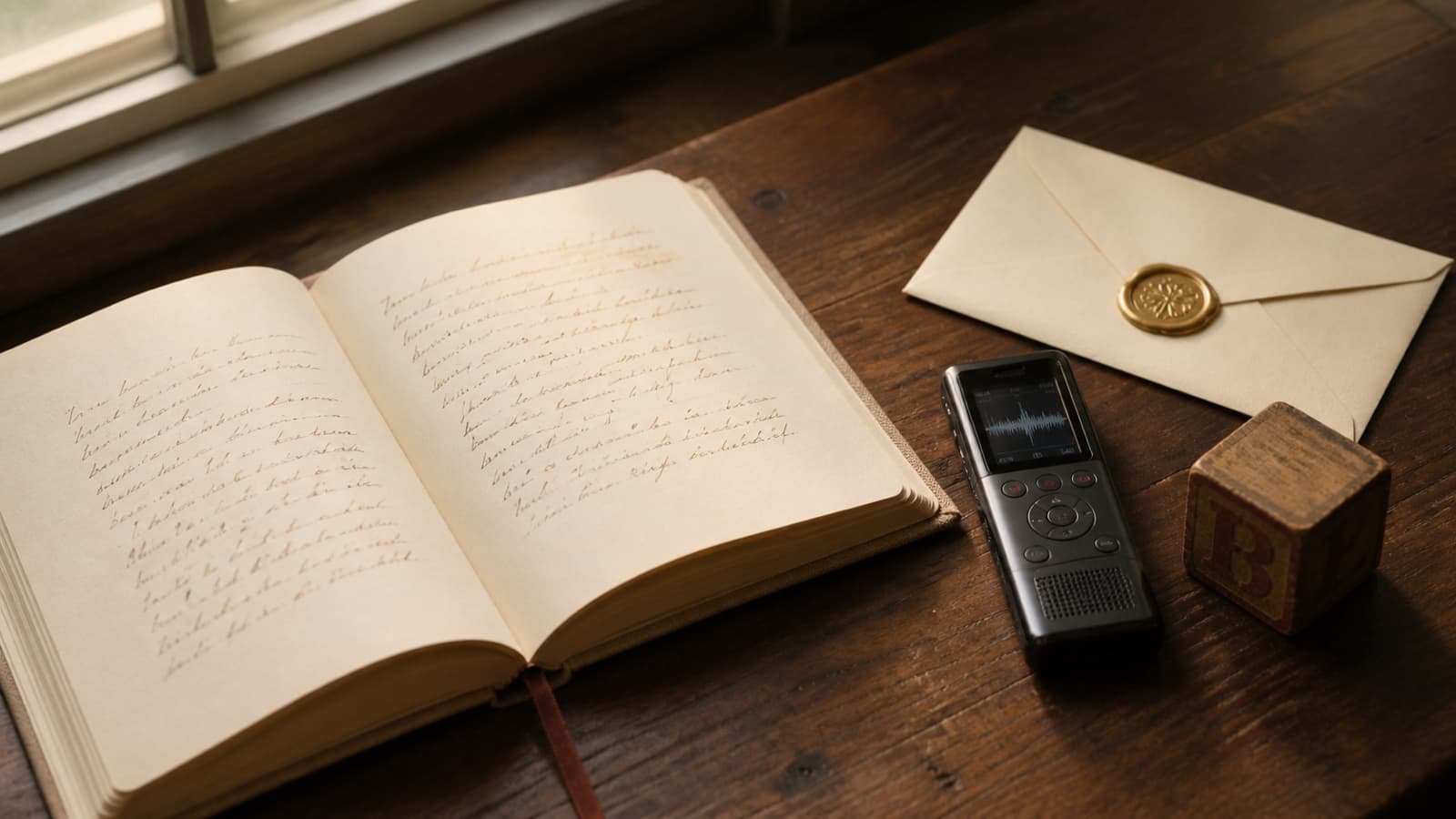
When Kelsey graduated from college, her parents gave her a journal they had kept throughout her childhood.
Month by month, they had written down what was happening in her life. They left her updates, notes and small pieces of days she would never have remembered on her own. They waited until she was older and chose a moment when it felt right to give it to her.
I loved what that journal represented. Her parents had quietly saved a version of childhood for her, then handed it back years later.
But as meaningful as it was, there was something a handwritten journal could not hold. It could tell her what she said. It could not let her hear herself saying it.
The voices we wish we still had
People understand the importance of a voice most clearly after it is gone. We save old voicemails because a voice carries something a photograph cannot. It has a person's rhythm, their laugh, the way they said your name and the pauses only they made.
I did not grow up knowing either of my grandfathers. They were alive when I was born, but not during the years I can remember. I had two grandmothers in my life, but no memory of what either grandfather sounded like.
I sometimes think about what it would be like to hear a message from them now. Not a formal speech or a perfect recording. Just their voices talking to me as their grandson.
Then our daughter started talking
A few months ago, our daughter's language seemed to change almost every day. She began saying all these small, funny and completely ordinary things that felt enormous to us because they were hers.
One of my favorites was “I love you, Dada.” I wanted to record it because I knew she would not say it in that same little voice forever. The words would stay with me. The sound of her saying them would change.
We already took plenty of photos and videos. Like most parents, our camera rolls were full. But the moments were scattered through thousands of files, mixed with screenshots, receipts and everything else a phone collects. There was no single place that felt as if it belonged to her.
The more I thought about Kelsey's journal, the more obvious the gap felt. I wanted our daughter to have something like it one day, but with the things the journal could never have kept: her own little voice, the photographs from those days, short videos and the voices of the people who loved her.
It started as something only our family needed
Tiny Treasures did not begin as a startup idea or a category we decided to enter. It began as a place for our own family.
Kelsey loved the idea immediately. Once we could use it, she kept finding more moments to add. We went back through the calendar, picked days from our daughter's life, looked through the photos from those dates and left messages behind them.
That is how features such as sharing directly from the Photos app came about. We were not trying to invent more things for the app to do. We were trying to remove every small obstacle we encountered while preserving our own memories.
We also wanted a family to be able to begin late. If someone finds Tiny Treasures when their child is two or three, their earlier life should not be gone. A parent can return to an older day, add the photos from it and record what they remember now. It will not be exactly the same as recording in the moment, but the story can still be kept.
The moment it became bigger than us
It felt real when we recorded our daughter saying something cute and shared it with our family. They had not been standing in the room when she said it, but hearing her made them feel as if they had been part of the moment.
That changed the idea. A grandparent could add their own messages. A relative who did not want another app could leave a voicemail. Parents could preserve not only what their child sounded like, but what the people around that child sounded like too.
When we tell other parents about Tiny Treasures, many say some version of the same thing: “I wish I had this when my children were little.” Their children may be grown, but they still remember the phrases and mispronunciations they would give anything to hear again.
That is when I knew this should not stay something only our family used.
What I hope she finds one day
I hope our daughter can eventually look through parts of her life she could never have remembered. Not just home videos, and not just a written list of milestones. I hope she hears the ordinary days.
I hope she hears how she pronounced words before she knew they were unusual. I hope she hears us laughing with her. I hope she hears messages from the people who were thinking about her, including the ones who may not be there when she is old enough to listen.
Most of all, I hope it feels like Kelsey's journal felt when her parents finally placed it in her hands, only with another dimension preserved inside it.
Childhood does not disappear all at once. A word changes. A voice becomes a little clearer. One day even “I love you, Dada” sounds completely different from the way it once did.
We cannot stop any of that, and we should not want to. We can keep enough of it that, years later, a family can press play and hear who was there.
What we built from that feeling
A short look at Tiny Treasures
See how a child's little voice and messages from the people who love them can live together in one private capsule.
30 seconds · Sound on